
Why Is My French Wash Patchy? The Four Real Causes
A patchy french wash is almost always a wet edge problem, not a product problem. French wash is a translucent glaze laid over a base coat and blended while it is still open. If any part of the wall starts to go off before you get back to it, you get a hard line or a dense patch — and once the glaze has set, you cannot blend it out. You re-glaze the wall, corner to corner.

Here are the four causes, in the order we actually find them. First: the wall was too big for the crew.
This is the one nobody expects. A french wash wall cannot be stopped halfway. The glaze stays workable for a limited window, and that window decides how much wall one person can cover before the first bit is already setting.
So the size of your wall dictates the crew size before anyone picks a colour. A 3m wall is one person. A double-height stairwell is not — and if someone quotes a stairwell as a one-person day, that is where your lap lines are coming from. It is a planning failure that shows up as a finish failure.
2. Auckland dried the edge before we got back to it
Everything that moves air across a wall shortens the working window. The heat pump has to be off, and stay off — this is the most common cause we see in occupied Auckland homes, because someone turns it back on just while the crew is at lunch. A dry westerly through open villa sashes does the same thing: villas breathe, which is lovely for the house and brutal for a glaze. February and July are genuinely different jobs. And you work the sunny wall early or late, never in the middle of the day.
Third: the base coat was not uniform. French wash is translucent — it shows you everything underneath it. If the low-sheen base coat was patchy, roller-lapped, or spot-primed in places and not others, the glaze does not hide that. It magnifies it, because glaze pools slightly differently over surfaces with different porosity.
If your french wash looks blotchy in a way that is even and repeating rather than random and streaky, the problem is usually not the glaze at all. It is the coat underneath, and no amount of extra glaze fixes it.
4. It is not patchy — it is meant to look like that
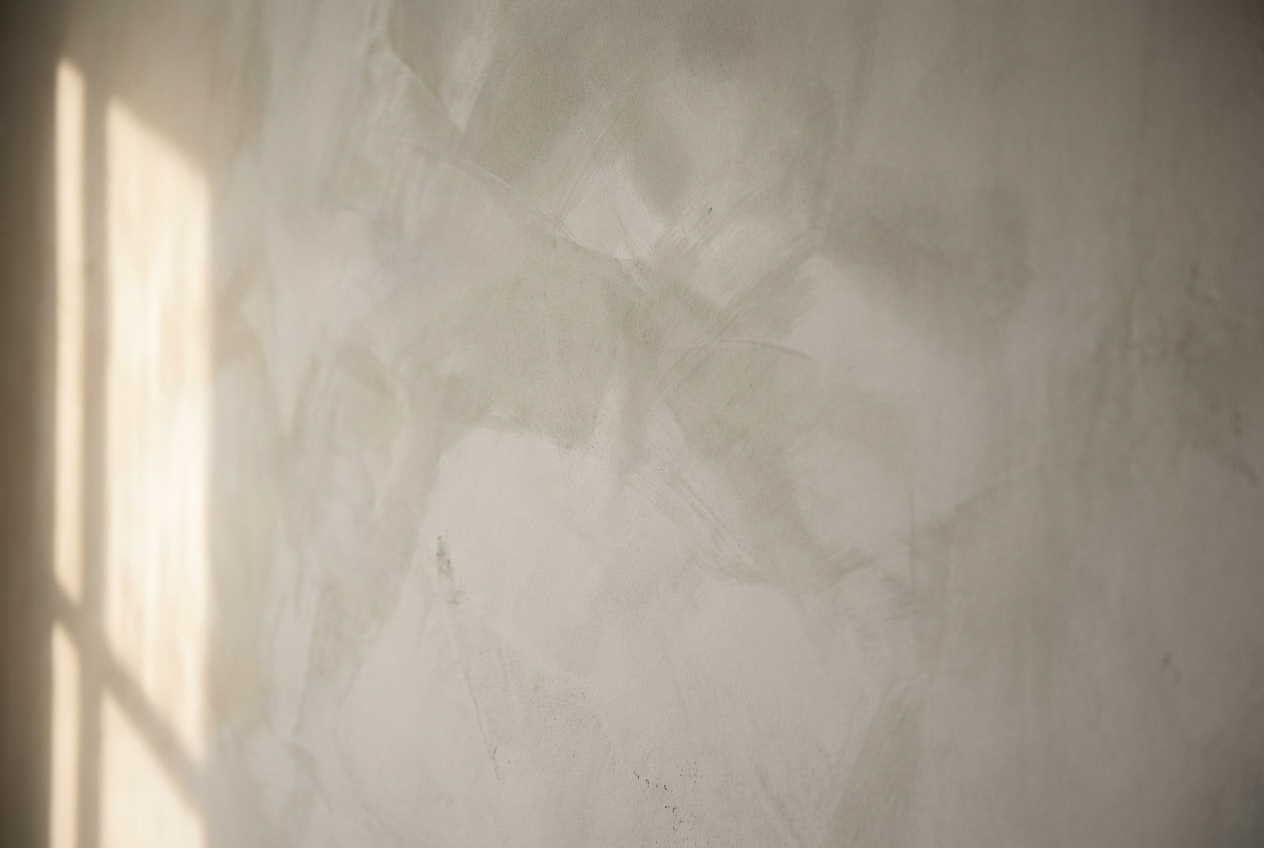
Worth saying plainly, because we get called out for this. French wash is not a flat colour. It is supposed to have cloudy movement and depth. That is the entire point, and the reason it costs more than paint. Photographed under a phone flash, good french wash can look patchy and then look beautiful in daylight.
The test: stand back two to three metres in normal daylight. Real depth reads as soft movement across the whole wall. A defect reads as a line, a hard edge, or a dense blotch your eye keeps returning to. If you can see where the applicator stopped, that is a defect. If you just see movement, that is the finish you paid for.
The same undulating, hundred-year-old lath-and-plaster wall that makes Fresco or polished plaster look like a mistake is exactly what makes french wash sing. Glaze gathers slightly in the low spots, and on a villa wall your eye reads that as depth rather than as a defect. So if you have been told your walls are too rough for a decorative finish — for french wash, specifically, that is often backwards.
What is fixable and what is not
A hard lap line where someone stopped: no, the wall gets re-glazed corner to corner. A dense blotch from a dried edge: same. Even, repeating blotchiness: not with glaze, because the base coat is the problem. Looks patchy in photos but fine in daylight: nothing to fix, that is french wash.
The honest bit is that there is no touch-up on a french wash wall. You cannot spot-fix a translucent glaze — any patch you lay in is a new wet edge with its own hard line. That is why the prep and the planning carry the job, and why a painter who has done one is a genuinely different proposition from a Porter's-trained applicator.
Can you touch up a french wash? No. Any touch-up creates its own edge. The unit of repair is the whole wall.
Why does my french wash look different in every photo? Because it is translucent and directional — it moves with the light. That is the product working.
Can french wash go over a painted wall? Yes. Unlike lime wash, it wants a sound low-sheen acrylic base coat. But that base coat has to be uniform, which is where most of the prep goes.
Is patchiness a Porter's product fault? Almost never. It is a wet-edge, base-coat or planning problem — all three are application, not product.
Thinking about a french wash wall?
We are Porter's-trained applicators working across Auckland. See the finish and real Auckland work on our French Wash page, or read what french wash costs in our full French Wash guide.