
Home / Decorative Finishes / Venetian Plaster
Venetian Plaster in Auckland
Polished Italian lime plaster with the depth, movement and cool lustre of solid stone. Applied by a Novacolor certified applicator — which on these systems is not a brag, it's the condition the 10-year warranty is written on.
 Master Painters
Member Novacolor certified applicator Porter's Applicators Guild $10m insured
The Finish
What is Venetian plaster — and why does it look like stone?
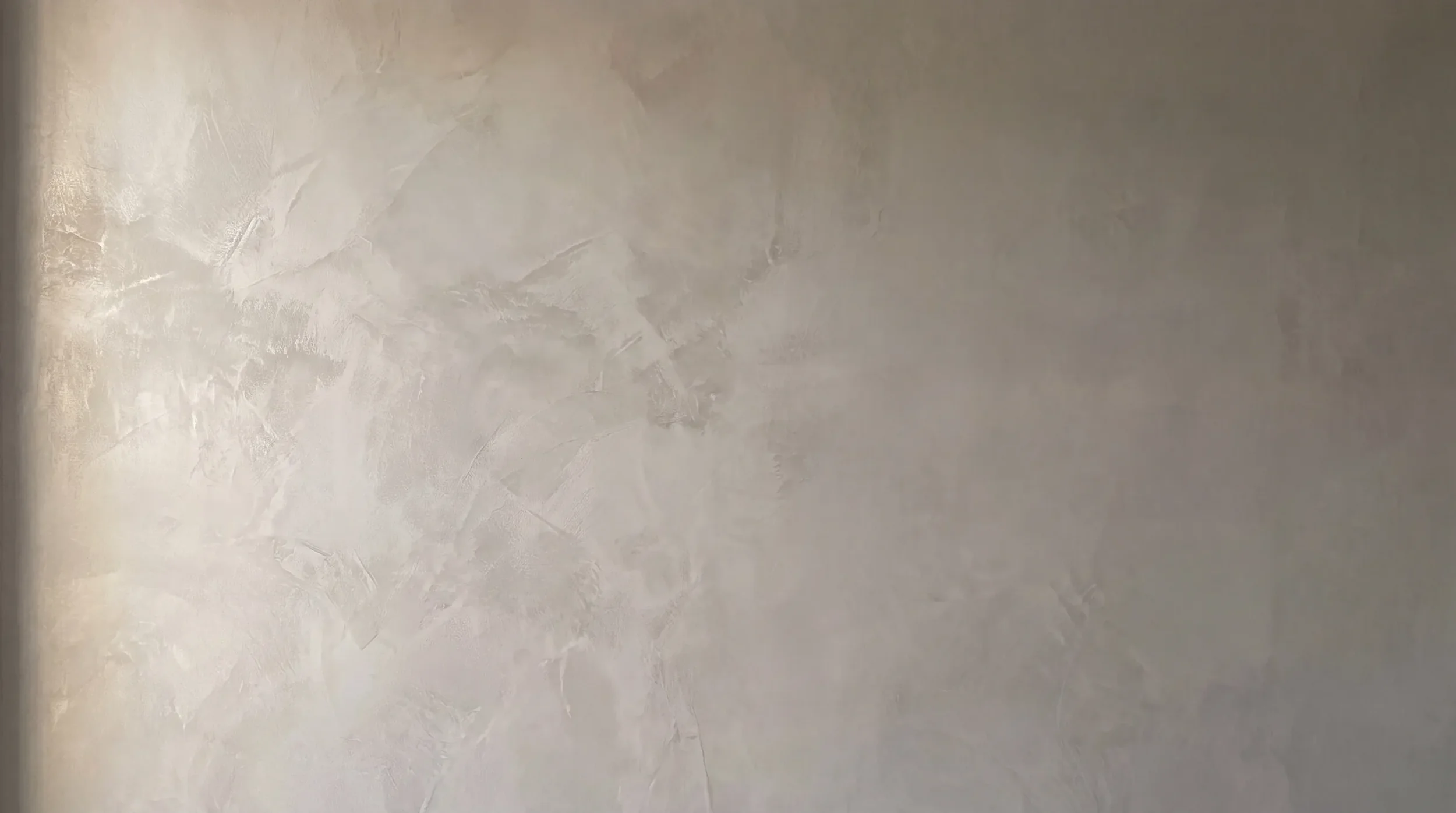
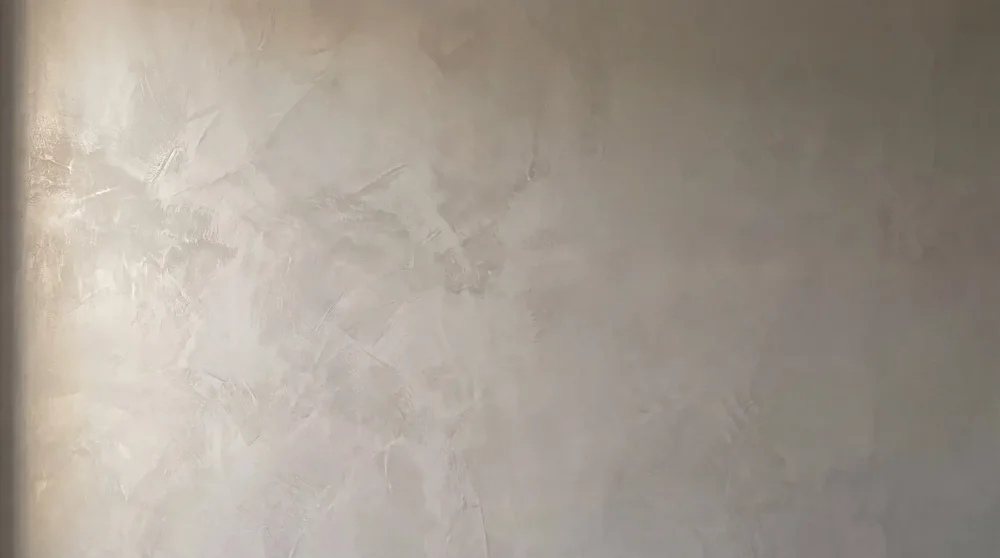
Venetian plaster is a lime-based plaster built up in ultra-thin layers and burnished back with a steel trowel. It isn't a paint effect and it isn't a texture coat. It's real slaked lime and marble dust, compressed until the surface takes on the cool, glassy depth of polished stone.
The look comes from what's underneath. Each coat is troweled in different directions, so light entering the wall passes through several layers before it reflects — which is why a Venetian plaster wall shifts as you walk past it and a painted wall never does. It's also breathable and naturally alkaline, which is why it sits so well on older Auckland plaster and masonry.
The name covers a whole family of finishes, not one product — and that's the thing most people get stuck on. The types are explained below, or jump to colours, cost, or a free instant estimate.
The types
Marmorino, Stucco Veneziano, Tadelakt — what's the actual difference?
"Venetian plaster" is a category, not a product. Nearly every enquiry we get starts with someone who has seen a finish they love and doesn't know what it's called. Here's the family, plainly.
| The finish | Texture & sheen | Best for |
|---|---|---|
| Marmorino | Fine marble aggregate, subtle stone-like movement. Matte to satin. | The default. Feature walls, whole rooms, ceilings. |
| Stucco Veneziano | The high-polish one. Glassy, mirror-like, deep marble veining. | Statement walls, entries, powder rooms, bars. |
| Grassello di Calce | Pure lime putty, very smooth, high sheen when burnished hard. | Formal rooms, heritage restoration, ceilings. |
| Tadelakt | Seamless, soapy-smooth, soft sheen. Traditionally soap-sealed. | Bathroom walls, vanities, curved forms, niches. |
| Travertino | Pitted and pored like real travertine stone. Matte. | Feature walls wanting visible stone character. |
| Concrete effect | Flat, cloudy, industrial. Matte, no polish. | Modern builds, commercial, minimalist interiors. |
| Metallic & oxidised | Pearlescent shimmer or rusted-iron patina. | Bars, retail, single dramatic walls. |
01
Marmorino
Literally "little marble". Slaked lime with finely crushed marble, which is what gives the surface its quiet stone-like movement. It's the most versatile of the family and the one we specify most often — it reads beautifully in a whole room without shouting. We apply Novacolor Marmorino KS.
02
Stucco Veneziano
The finish most people picture when they say "Venetian plaster": burnished to a genuine polish, almost wet-looking, with deep marble veining that moves as the light moves. It's the most labour-intensive of the range, and it wants a single well-lit wall rather than a whole house.
03
Tadelakt
Moroccan in origin, seamless and slightly soapy to the touch, with a soft rather than glassy sheen. The one lime finish with a genuine claim to bathroom walls, because it's traditionally sealed to shed water. We apply Novacolor Archi+ Tadelakt.
04
Travertino & textured limes
Where Marmorino is smooth, these carry real physical texture — the pits and pores of travertine, or the coarse grain of a natural aggregate. Best where you want the wall to be touched as well as looked at.
05
Matte lime & clay
The quietest end of the family: chalky, powdery, no sheen at all. Closer in feel to lime wash but with real plaster body. Novacolor Calce Cruda is the one we reach for in bedrooms and snugs.
06
Concrete effect
Flat, cool and cloudy — the poured-concrete look without the slab. Suits modern Auckland builds with black joinery, and it's the finish most often asked for by architects rather than homeowners.
Not sure which one you've seen?
Send us the photo. Nine times out of ten we can name the finish off a screenshot, and tell you honestly whether it's the right call for your wall and your light.
Colour
Venetian plaster colours that work in Auckland light
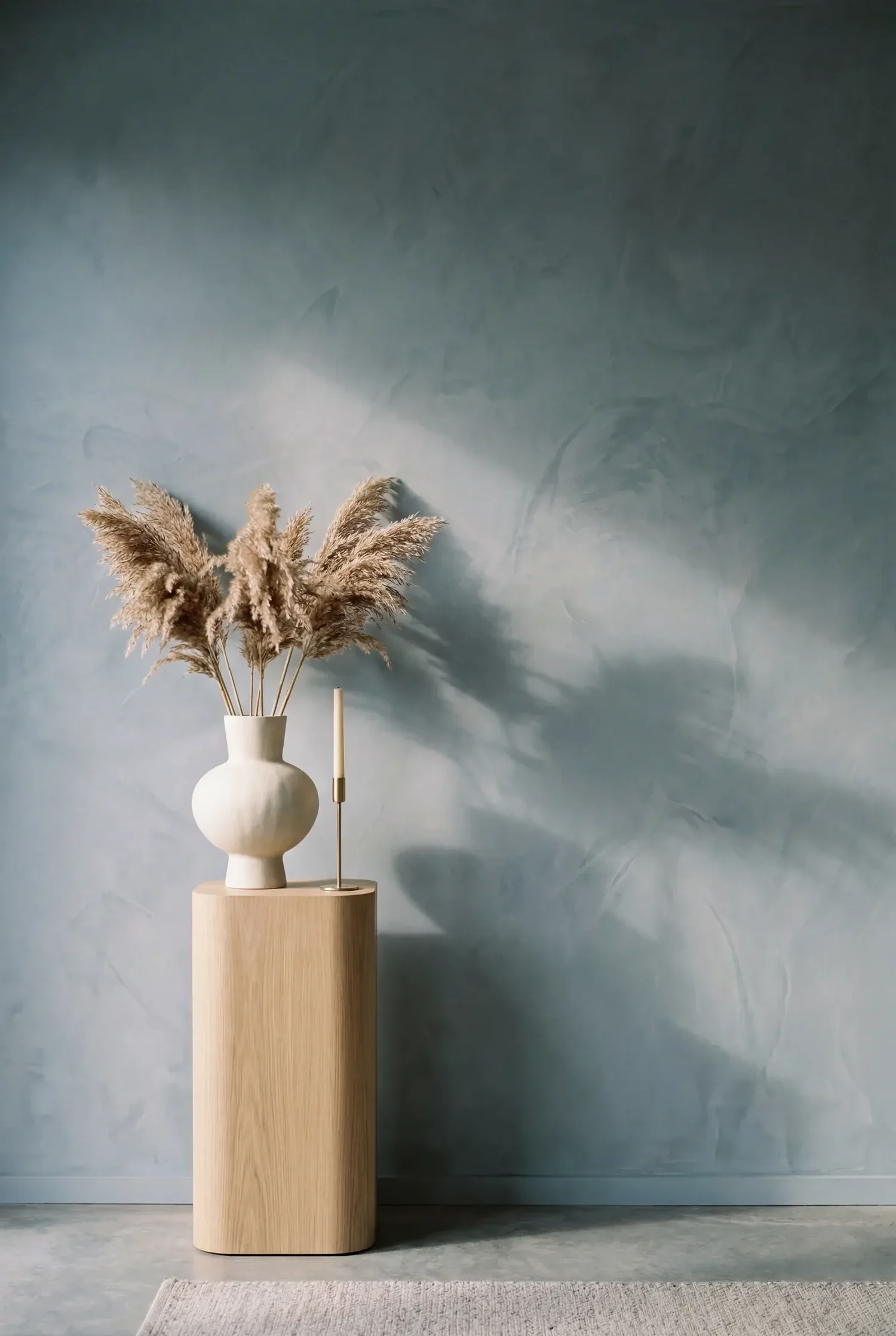
Lime plaster is tinted, not painted, so the colour sits inside the surface and shifts with the light through the day. Auckland's light is bright but often overcast, which flatters the warm neutrals and can make cold greys read grey-blue and lifeless. This is the palette that actually works here.
| Colour family | How it reads | Where it works |
|---|---|---|
| Warm white & bone | Soft, luminous, never sterile. The safest choice and the most requested. | Whole rooms, ceilings, villas, north-facing living |
| Greige & putty | The quiet workhorse. Reads warm in daylight, deeper under lamps. | Living rooms, hallways, open plan |
| Clay, sand & terracotta | Earthy warmth with visible movement. Very current. | Feature walls, bedrooms, fireplaces |
| Stone grey & taupe | Warm-leaning greys. Avoid the cold blue-greys in Auckland light. | Modern builds, bathrooms, kitchens |
| Deep charcoal & ink | Dramatic and enveloping. Shows the burnish best of any colour. | Dining rooms, bars, powder rooms, media rooms |
| Muted green & olive | Softer than a painted green because of the tonal movement. | Studies, bedrooms, joinery-heavy spaces |
Two things worth knowing. It dries lighter than it goes on, so wet plaster is never the colour you're judging. And a sample board in a showroom tells you almost nothing — the same plaster reads differently on a north wall and a south wall in the same house. We bring boards to site and leave them with you for a few days so you see them in your own light, morning and night, before anything is ordered.
Where it works
Where Venetian plaster suits Auckland homes
One wall is usually all it takes. Venetian plaster is a statement finish — it works best where the room already wants a focal point.
01
Feature walls
The classic. A single polished wall behind a bed, sofa or dining table gives a room the weight of a stone building.
02
Fireplaces & chimney breasts
Plaster wrapping a fireplace reads as solid, carved mass — the effect people are chasing when they say "monolithic".
03
Stairwells & entries
Tall walls with raking light are where burnished plaster earns its money. The movement is strongest where the light is sharpest.
04
Kitchens & splashbacks
Sealed Venetian plaster handles a splashback and island face beautifully — seamless, wipeable and far warmer than a glass panel.
05
Ceilings & niches
Colour-drenching a ceiling or a nook in the same plaster is the detail that makes a room feel designed rather than decorated.
06
Hospitality & retail
Bars, showrooms and clinics — a hard-wearing mineral surface that photographs far better than paint and ages instead of scuffing.
What it goes over
Can you put Venetian plaster on that wall?
Usually yes — but the substrate decides how much prep the quote carries, and prep is the single biggest variable in the price. Here's the honest answer for each.
| Surface | Can we? | What's involved |
|---|---|---|
| New Gib / plasterboard | Yes — ideal | Needs a Level 5 finish. Level 4 will telegraph joints through a polished surface. |
| Existing painted walls | Yes | Sand, make good, then a keyed primer so the plaster has something to grip. |
| Solid plaster / render | Yes | Often the best substrate there is, once cracks are cut out and made good. |
| Brick & block | Yes | Needs a levelling render coat first. Adds cost, but the result is superb. |
| Villa lath & plaster | Usually | Depends on how sound it is. We probe it before quoting rather than after. |
| Existing tiles | Not recommended | Movement and grout lines telegraph. Use microcement instead. |
| Inside a shower | No | It's not a waterproofing system. Microcement is. |
| Exterior walls | Case by case | Some lime systems are rated for it. Auckland's rain and salt air narrow the options — ask us. |
The short version: flat and sound beats new every time. We'd rather plaster a hundred-year-old wall that's been made good properly than a new Level 4 board.
Room by room
Venetian plaster in every room — what actually works
The honest version, including the rooms where we'd steer you somewhere else.
| Room | Our call | Why |
|---|---|---|
| Living & dining | The sweet spot | Big walls, good light, and the room you sit in longest. Marmorino on one wall, or colour-drench the lot. |
| Bedrooms | Yes — go matte | A polished sheen can feel cold behind a bed. Calce Cruda or a matte lime reads softer and calmer. |
| Entry & stairwell | Best value in the house | Tall walls, raking light, and it's the first thing anyone sees. The movement is strongest here. |
| Bathrooms | Yes, with conditions | Walls away from direct spray, vanity walls, and Tadelakt where you want a wet-look finish. Not inside the shower. |
| Kitchens | Yes — seal it | Splashbacks and island faces work beautifully sealed and waxed. Seamless, wipeable, warmer than glass. |
| Fireplaces | The most-requested | Wrapping a chimney breast reads as carved solid mass. Heat is not an issue away from the firebox itself. |
| Ceilings | Underrated | Plastering the ceiling in the same tone is the detail that makes a room feel designed. Slow to apply, worth it. |
| Hallways | Yes — wax it | Bags, shoulders and dog tails. Sealed and waxed it takes the traffic; unsealed in a narrow hall it will mark. |
| Laundries & WCs | Great small win | Small rooms are cheap to do and high impact. A powder room in deep charcoal Stucco Veneziano is a showpiece. |
| Inside showers | No — use microcement | Not a waterproofing system. Microcement is, and it's wet-area compliant. |
| Exterior walls | Case by case | Some lime systems are rated for it, but Auckland rain and salt air narrow the options. Ask before you plan it. |
Why it suits New Zealand
Lime plaster and the way Kiwi houses actually behave
This is the part nobody else writes about, and it's the strongest practical argument for lime plaster in this country. New Zealand homes are damp. We have high humidity, long wet winters, and a huge stock of older houses that were built to breathe and have since been wrapped in modern sealed paint.
Lime plaster is vapour-permeable. Moisture moves through it instead of being trapped behind a plastic film, which is exactly what a villa's original walls were designed to do. Seal those walls with a modern acrylic and the moisture has nowhere to go but into the timber behind.
Lime is naturally alkaline, at a pH that mould does not enjoy. It's not a mould treatment and we won't claim it is — if you have a moisture problem you need to fix the moisture problem — but in a bedroom that runs a bit damp, a breathable mineral wall behaves very differently to a sealed painted one.
And it gets harder with age. Lime slowly reabsorbs carbon dioxide and returns toward the limestone it started as. Paint is the only wall finish you own that begins failing the day it dries; lime plaster is the opposite.
Before you hire anyone
What goes wrong with Venetian plaster — and how to avoid it
Most of the bad Venetian plaster in Auckland isn't bad product. It's the wrong hands, or the right hands rushed. Four questions worth asking whoever you get a price from — including us.
| Ask them | What a good answer sounds like |
|---|---|
| "Are you certified with the manufacturer?" | A named certification, not "we've done heaps of it". On Novacolor and Cemher the warranty is void without it. |
| "What level will you prep the wall to?" | Level 5, and they should raise it before you do. If they don't mention prep, the joints will telegraph. |
| "How many coats, and how long on site?" | Coats named, days given. Two days for a feature wall is realistic; one day is someone skipping a coat. |
| "Can I see a sample in my own room?" | Yes, and they leave it with you. A showroom board in showroom lighting tells you almost nothing. |
The three failures we get called to fix: telegraphing (joints and ripples showing through because the wall wasn't made good), patchiness (coats applied too fast, or burnished after the window closed), and dusting (wrong primer, so the plaster never properly keyed to the wall). All three are prep and process, not product — and all three are expensive, because the only honest fix is to take it back off.
The honest comparison
Venetian plaster vs microcement
This is the question we get asked most, and the honest answer costs us nothing — we're certified in both, so we have no reason to push you to the wrong one.
| Venetian Plaster | Microcement | |
|---|---|---|
| Made of | Slaked lime and marble dust — a mineral plaster | Cement-based polymer-modified system |
| Look | Polished, glassy depth with marble-like movement | Matte to satin, even stone-like tone, subtle trowel texture |
| Build-up | Very thin — layers measured in fractions of a millimetre | 3-4mm over the existing surface |
| Wet areas | Not for showers. Splashbacks yes, wet rooms no | Made for them — fully waterproof system, wet-area compliant |
| Floors | Walls and ceilings only | Walls, floors, benchtops and stairs |
| Over tiles | No | Yes, over sound tiled surfaces |
| Best for | Feature walls, fireplaces, stairwells, ceilings | Bathrooms, showers, seamless floors, benchtops |
Straight answer: if it's a wall you want to look carved from stone, it's Venetian plaster. If water is going to hit it or you're going to walk on it, it's microcement. Plenty of homes use both — plaster in the living room, microcement in the bathroom.
The other options
Venetian plaster vs lime wash, paint and wallpaper
All four get called "a textured feature wall" by someone. They behave completely differently, and they're not close on price.
| Depth | Durability | Relative cost | The catch | |
|---|---|---|---|---|
| Venetian plaster | Deepest — real stone-like polish | Decades. A mineral surface, not a film | Highest | Wants a flat substrate and a skilled hand |
| Lime wash | Soft, chalky, cloudy | Ages rather than fails | Around a third of Venetian | Matte only — no sheen, no polish |
| French wash | Watercolour movement over a base coat | Good, it's a glaze over paint | Lower again | Softer effect, less physical presence |
| Textured paint | Shallow, repeats visibly | Standard paint life | Lowest | Reads as paint close up, every time |
| Plaster-look wallpaper | Printed, so it repeats | Seams, and it can lift | Low to mid | No depth under raking light. It's a photo of plaster |
We apply the first three and we'll tell you when lime wash is the smarter spend. If the budget is tight and the room is big, a beautifully executed lime wash beats a rushed Venetian every time.
The two systems we apply
Novacolor or Porter's Fresco — which one your wall wants
We're certified across two systems, and they suit different jobs and different budgets.
01
Novacolor — the Italian system
The real thing: lime and marble plasters made in Italy. Marmorino KS for smooth satin walls with tonal movement, Archi+ Tadelakt for a polished spa-like sheen, Teodorico for the semi-polished marble look, Calce Cruda for a soft matte lime-and-clay finish. Deepest, most authentic result, and it carries a 10-year product warranty when a certified applicator lays it down.
02
Porter's Fresco — the lighter route
Porter's own polished plaster: thinner, softer-sheen, applied in fewer coats. It gets you most of the way to the burnished stone look for less time on site, which often makes it the smarter spec on a large wall or a tighter budget. Applied under our Porter's Applicators Guild accreditation.
How we apply it
Venetian plaster done properly, start to finish
Consult & sample
We look at the wall, the substrate and the light through the day, then leave real plaster sample boards with you — colour and sheen signed off before anything is ordered.
Free · No obligationSubstrate preparation
Polished plaster is unforgiving: every flat spot and every ripple shows. Walls are made good to a Level 5 standard and primed with the system's own base before a trowel touches them.
Layered application
Base coat, then the thin colour coats, each troweled in crossing directions and left to pull. This is where the depth is made — it cannot be added later.
Burnish & seal
The surface is compressed with a clean steel trowel until it takes its sheen, then sealed or waxed to suit the room. We hand over with care guidance.
What does Venetian plaster cost?
From $200/m², and the wall decides the rest.
Venetian plaster is a multi-coat, hand-burnished system, so it's priced by the surface, the prep and the sheen level — not by the litre. A single feature wall is the usual entry point.
Porter's Fresco — from around $200/m² incl GST, the value route to the polished look
Novacolor systems — priced above Fresco. Italian lime plaster costs more in the tin and takes more coats
Minimum charge $1,500 incl GST on any feature wall. A small wall is the same setup, masking and mixing as a big one
Prep is the biggest variable. A sound flat wall is cheap to prepare; a cracked villa wall is not
A typical 8-12m² feature wall lands around $1,800-$3,200. A full feature room of roughly 35m² starts around $8,000. Those are indicative, not a quote — read the full 2026 Auckland price guide.
Price your Venetian plaster wall
Tell us the room or wall, pick the finish, get your indicative number in about a minute.
Try the free estimator → Or book a free consult No obligation · No spam · Just a clear next stepLiving with it
Looking after a Venetian plaster wall
Almost nothing, which is the point. But there are three things worth knowing before you commit.
01
Cleaning
Dust it, or wipe with a barely damp cloth. No abrasives, no bleach, nothing acidic — lime is alkaline and acid etches it. Sealed and waxed walls in kitchens tolerate a mild soap.
02
Knocks and scuffs
Because the colour runs through the plaster rather than sitting on top, a light scuff often burnishes out with a soft cloth. Deeper damage is patched and re-burnished — unlike paint, it can be made invisible.
03
How long it lasts
Decades. It's the same material still standing on Italian buildings centuries later. It doesn't peel or flake because it isn't a film — it's part of the wall.
Designers, architects & builders
Specifying Venetian plaster on a project
A decent chunk of our plaster work comes through designers rather than direct. Here's how we work with you.
01
Pricing from plans
Send elevations and we'll price off them — no site visit needed to get a budget number into a schedule. We'll flag where the substrate spec needs to change to carry the finish.
02
Sample boards for clients
Real plaster on board, in the actual colour and sheen, for your presentation. We'll do multiple options side by side so the client chooses from material, not a render.
03
Written specification
If you need spec text for a tender we'll write it — system, coats, substrate standard, sealer and maintenance. Named products, so the price you get back is comparable.
04
The Level 5 conversation
The single most common project problem: plaster specified over a Level 4 board finish. We'd rather raise it at design stage than argue about telegraphing at handover.
05
Sequencing
Plaster goes on late, after the dust-making trades and before final fit-off. We'll tell you where it sits in your programme and how many days to hold.
06
Your client or ours
We'll invoice you or your client, present in your name or ours, and stay out of the way if you'd rather we weren't in the room. Master Painters accredited, $10m insured, Site Safe.
Plain English
The words you'll hear, translated
Quotes for this work are full of jargon. Here's what it all actually means, so you can compare two prices properly.
| Term | What it means |
|---|---|
| Slaked lime | Limestone burnt and then soaked in water. The binder in every finish on this page — what makes it breathable and alkaline. |
| Burnishing | Compressing the surface with a clean steel trowel. Not polishing with a cloth — it's pressure, and it's where the sheen comes from. |
| Marble dust | The aggregate. How finely it's ground decides whether you get a smooth polish or a visible stone texture. |
| Level 4 / Level 5 | Plasterboard finishing standards. Level 4 is normal for paint. Polished plaster needs Level 5 or joints telegraph through. |
| Telegraphing | When what's underneath shows through the finish — joints, patches, ripples. The most common failure, and it's a prep failure. |
| Keyed primer | A gritty primer that gives the plaster something to grip. Skip it and the finish can dust off the wall later. |
| Sheen level | How reflective the finished surface is, from dead matte to mirror polish. Decided by the product and how hard it's burnished. |
| Patina | The way the surface changes with age and light. On lime it's a feature, not wear. |
| Carbonation | Lime reabsorbing CO2 and hardening back toward limestone. Why these walls get tougher over years rather than degrading. |
Where we work
Venetian plaster across Auckland
We cover Auckland wide for decorative work, and most of our plaster jobs land in the central and eastern suburbs where the villas and the renovations are.
Auckland wide
Ponsonby, Herne Bay, Grey Lynn, Westmere, Remuera, Epsom, Parnell, Mount Eden, Kingsland, Devonport, Takapuna, Milford, Mission Bay, Saint Heliers, Titirangi and the wider region. Outside the city? Ask — we travel for the right job.
Keep exploring
Not sure Venetian plaster is the one? Compare the family.
Harder and glossier than lime wash, more mineral than a glaze — here's where Venetian plaster sits next to our other signature finishes.
Microcement
The waterproof one. Seamless walls, floors and showers at 3-4mm — and it goes straight over existing tiles.
Explore microcement →
Lime Wash
The soft one. Chalky, breathable and cloudy rather than polished — made for villas and quiet rooms.
Explore lime wash →
French Wash
The warm one. Layered, watercolour-like movement — the softest feature wall in the range.
Explore French wash →Good to know
Venetian plaster questions, answered
How much does Venetian plaster cost in Auckland?
Porter's Fresco starts from around $200/m² including GST, and the Novacolor Italian systems price above that because the material costs more and the build-up takes more coats. A typical 8-12m² feature wall lands around $1,800-$3,200; a full feature room of roughly 35m² starts around $8,000. There's a $1,500 minimum on any feature wall, because a small wall involves the same setup, masking and mixing as a large one. The biggest variable is prep — a sound flat wall is cheap to prepare, a cracked villa wall is not. Full detail in our 2026 Auckland price guide, or get an indicative number from the free estimator.
What's the difference between Venetian plaster and Marmorino?
Marmorino is a type of Venetian plaster, not an alternative to it. "Venetian plaster" is the family name for lime-and-marble plasters burnished with a trowel; Marmorino ("little marble") is the specific one made with finely crushed marble aggregate, which gives a subtle stone-like movement and a matte-to-satin sheen. If someone shows you a plaster wall that looks like soft stone rather than polished marble, it's almost certainly Marmorino. The high-gloss mirror version is Stucco Veneziano.
What's the difference between Venetian plaster and polished plaster?
In practice, nothing — two names for the same family of burnished lime plasters. "Venetian plaster" is what most people search for and what the look is called; "polished plaster" is the trade term. Porter's call their version Fresco. We apply both the Novacolor Italian system and Porter's Fresco, and which one suits depends on the size of the area, the sheen you want and the budget.
Can Venetian plaster go in a bathroom or shower?
Around a bathroom, yes — walls away from direct water, and splashbacks, seal up well, and Tadelakt is the traditional choice here because it's sealed to shed water. Inside a shower enclosure, no. Venetian plaster is not a waterproofing system and shouldn't be asked to be one. For seamless walls and floors in a wet area the right product is microcement, which is a fully waterproof system and wet-area compliant. We're certified in both, so we'll point you to whichever one your room actually needs.
Can you apply Venetian plaster over existing painted walls?
Yes, and it's one of the most common situations we quote. The wall is sanded, made good, and primed with a keyed primer that gives the plaster something to grip. What matters more than the paint is how flat the wall is — a polished surface telegraphs every ripple and every taped joint, so anything less than a Level 5 standard gets made good first. That prep is usually the biggest single variable in the price.
Can it go over Gib, brick or tiles?
Gib: yes, and it's ideal — but it needs a Level 5 finish, not the Level 4 most builders stop at. Brick and block: yes, with a levelling render coat first, which adds cost but gives a superb result. Tiles: not recommended — movement and grout lines telegraph through. Use microcement over tiles instead. Villa lath and plaster: usually fine if it's sound, which we probe before quoting rather than after.
Which Venetian plaster colours suit Auckland homes?
The palette that works here runs from warm whites and bone through greige, putty and clay, into deep charcoals and inky greens for dining rooms and bars. The one to be careful with is cold blue-grey — under Auckland's often-overcast light it can read flat and lifeless, where a warm-leaning stone grey stays alive. Because the finish is burnished by hand every colour carries movement rather than sitting flat, and it dries lighter than it goes on. We leave sample boards with you for a few days so you see them in your own light, morning and night.
Does Venetian plaster crack or chip?
Applied over a stable, properly prepared substrate it's a hard mineral surface that wears very well — it's the same material still on the walls of Italian buildings centuries later. Cracking almost always traces back to movement in the wall behind it or skipped preparation, not the plaster. We assess the substrate first and will tell you up front if a wall isn't a good candidate. Knocks in high-traffic corners can be repaired and re-burnished, and because the colour runs through the material rather than sitting on top, repairs disappear in a way paint repairs never do.
How do you clean a Venetian plaster wall?
Dust it, or wipe with a barely damp cloth. Avoid abrasives, bleach and anything acidic — lime is alkaline, and acidic cleaners will etch the surface. Walls that have been sealed and waxed, which is what we'd specify for a kitchen or a hallway, tolerate a mild soap. Light scuffs will often burnish back out with a soft dry cloth.
How long does it last?
Decades, and it improves rather than degrades. Venetian plaster isn't a film sitting on the wall like paint, so there's nothing to peel, flake or blister — it's a mineral surface that is part of the wall and continues to harden with age. That's the real argument for the cost: you're not on a seven-year repaint cycle.
Why does a certified applicator matter?
Two reasons. First, the result: the depth in a Venetian plaster wall comes from how the coats are laid and burnished, and there's no way to fix that after the fact — a poor application can't be sanded back and improved, it has to come off. Second, the warranty. Novacolor's 10-year product warranty is written on the system being built up correctly, so an uncertified application can void the thing you're paying a premium for. We hold Novacolor certification and are members of the Porter's Applicators Guild.
Can I do Venetian plaster myself?
Honestly, this is the one finish we'd talk you out of. Lime wash is forgiving and a keen DIYer can get a good result. Venetian plaster is not — the burnishing window is short, the trowel angle decides everything, and mistakes can't be sanded out because the colour runs through the material. Add that the proper Novacolor and Porter's systems are only sold through trade channels to trained applicators, and the DIY route usually ends in a wall that has to be skimmed and started again.
How long does a Venetian plaster wall take?
Most single feature walls run two to four days on site, depending on the size of the wall, how much making-good the substrate needs and how many coats the finish calls for. Each layer has to cure before the next goes on, so it isn't a job that can be rushed — and the burnishing pass at the end is what the whole finish rests on. A full room is typically a week or more. We'll give you exact days with the quote.
Do you work with designers and architects?
Constantly, and it's a lot of what we do. We price from plans and elevations, supply sample boards for client presentations, and work either directly with your client or entirely through you. We're Novacolor and Cemher certified, members of the Porter's Applicators Guild, Master Painters accredited, $10m insured and Site Safe. If you need a spec written for a tender, we'll write it.
Let's begin
One wall, carved from light.
Auckland homeowners, designers and architects trust Key Painting to apply Venetian plaster properly — certified, warranted and sampled in your own light before a trowel touches the wall.
